



















































































































































12 Ways to Improve Work-Life Balance and Protect Your Health
Author: RVLNSV PRASAD
Updated On: October 2026
About Us
Author Bio
Editorial Policy
Contact Us
Quick Answer
Work-life balance and health are closely connected, but balance does not mean dividing every day into perfectly equal amounts of time for work, exercise, family, sleep, and relaxation. Real life rarely works that way, particularly when people have demanding jobs, children, caregiving responsibilities, long commutes, or unpredictable schedules.
A healthier approach is to protect the basics your body and mind need while creating reasonable boundaries around work. That can include getting enough sleep, moving throughout the day, eating regular nutritious meals, taking genuine breaks, limiting unnecessary after-hours communication, and maintaining meaningful relationships.
The World Health Organization explains that work can support mental health by providing purpose, income, and social connection, while poor working conditions, excessive demands, low control, and other psychosocial risks can harm mental health. WHO: Mental Health at Work
This is why work-life balance should not be treated only as a productivity challenge. Sometimes the healthiest solution is not another productivity technique. It may involve changing workload, communication expectations, schedules, or workplace support.
Introduction: Your Health Should Not Be the Price of Your Career
There was a period when I thought being busy automatically meant being productive. Long working hours seemed normal, and checking messages late at night felt like a harmless part of getting things done. The problem became obvious only after those small decisions started affecting sleep, movement, energy, and personal time.
That experience changed how I think about work-life balance and health.
Balance is not about creating a perfect schedule that looks impressive on paper. It is about building a life in which work has an important place without allowing it to consistently consume the habits that protect your physical and mental health.
This distinction is becoming increasingly important as more people deal with high workloads, digital communication, and work that follows them outside traditional working hours.
The World Health Organization identifies excessive workload, long or unsocial working hours, limited control, lack of support, and other psychosocial risks as factors that can contribute to workplace stress and poor mental health. WHO: Mental Health at Work
The CDC likewise recognizes that work-related stress can affect well-being and may be associated with problems such as sleep difficulties, fatigue, difficulty concentrating, and feeling overwhelmed. CDC: Supporting Worker Mental Health
So this guide takes a practical approach. Instead of telling you to follow an unrealistic morning routine or eliminate all stress from your life, it focuses on small strategies that can protect health while work remains demanding.
What Does Work-Life Balance Really Mean?
Work-life balance does not require spending exactly half your time working and half your time relaxing.
A parent with young children, a hospital worker, a business owner, a remote employee, and someone working rotating shifts will all have different responsibilities. Expecting them to follow the same schedule would make little sense.
A more useful definition is
Work-life balance means having enough control, recovery, and personal time to meet important work responsibilities without consistently sacrificing essential physical, mental, social, and personal needs.
This definition also recognizes something important: not every work problem can be solved by changing your personal habits.
If someone is routinely expected to work excessive hours, respond to messages late at night, and complete an unrealistic workload, telling that person to meditate for five minutes does not address the underlying problem.
WHO’s workplace recommendations therefore include both individual and organizational approaches, such as improving working conditions, training managers, and providing appropriate support for workers. WHO: Guidelines on Mental Health at Work
Why Work-Life Balance and Health Matter
Work can have positive effects on health. It can provide income, purpose, social connection, structure, and opportunities to develop skills. At the same time, unhealthy working conditions can contribute to stress, exhaustion, poor recovery, and other health problems.
The relationship becomes especially important when working hours are consistently excessive.
A joint WHO and International Labour Organization analysis found that working 55 or more hours per week was associated with a higher risk of stroke and ischemic heart disease compared with working 35–40 hours per week. The analysis estimated that long working hours were associated with 745,000 deaths from stroke and ischemic heart disease in 2016. WHO/ILO: Long Working Hours and Health
This does not mean that every person working long hours will develop heart disease or stroke. It does mean that consistently excessive working time should not be viewed only as a productivity issue.
For some people, it can become a genuine health concern.
My Personal Experience: Why Small Boundaries Matter
I learned that work-life imbalance rarely appears in one dramatic moment. More often, it develops through repeated compromises that seem reasonable at the time.
A walk gets postponed because of unfinished work. Dinner becomes something eaten quickly at the desk. Bedtime moves later because one more task needs attention. Personal conversations are delayed until the weekend, and eventually the weekend becomes another opportunity to catch up on work.
None of these choices necessarily causes a problem by itself. The difficulty comes when they become the normal pattern.
What helped me was not creating a complicated lifestyle plan. I started protecting a few basic behaviors instead, including regular movement, better sleep habits, reduced unnecessary screen use, and clearer boundaries around work.
The experience taught me one principle that still matters:
A healthy routine should be able to survive an imperfect day.
12 Ways to Improve Work-Life Balance and Protect Your Health
1. Protect Your Sleep Before You Optimize Productivity
Sleep is often the first health habit people sacrifice when work becomes demanding. That can create a difficult cycle because shorter sleep may leave you tired the next day, making concentration and productivity harder and encouraging even more late-night work.
Rather than treating sleep as leftover time, make it part of your work-life balance strategy.
The CDC recommends that adults generally get at least seven hours of sleep each night, although individual sleep needs vary. Maintaining consistent sleep and wake times and creating a relaxing sleep environment are among the habits that can support healthier sleep. CDC: About Sleep and Sleep Health
Try this: Create a work shutdown time rather than simply setting a bedtime.
For example, you might stop routine work at 9:30 PM, reduce stimulating screen use afterward, and begin your normal bedtime routine. The exact time matters less than creating a predictable transition between work and sleep.
2. Stop Waiting for a Free Hour to Exercise
One of the most common work-life balance mistakes is believing that exercise only counts when you have 45 or 60 uninterrupted minutes.
Short periods of movement can be easier to maintain, particularly for people with unpredictable schedules.
Research supports the idea that workplace interventions can reduce sedentary behavior. A 2024 systematic review and meta-analysis involving 24 studies and more than 3,000 participants found that workplace interventions reduced sitting time by approximately 38 minutes per workday overall. PubMed: Workplace Sedentary Behavior Interventions
An umbrella review has also found evidence supporting workplace strategies such as sit-to-stand workstations and other interventions for reducing sedentary time. PubMed: Workplace Physical Activity and Sedentary Behavior
You do not need to turn every break into a workout. The more practical goal is to interrupt prolonged sitting and make movement a normal part of the workday.
Try this: After a long period of sitting, stand up, walk around for five minutes, or take the stairs when practical.
3. Build a “Minimum Healthy Day”
Some routines fail because they have only two settings: perfect or abandoned.
Instead, create a minimum version of your routine for difficult days.
On a normal day, you might have time for a 30-minute workout. On an extremely busy day, your minimum could be a 10-minute walk, one balanced meal, adequate fluids, a short break from screens, and a reasonable opportunity for sleep.
This approach helps prevent the all-or-nothing mindset that makes one difficult day turn into an entire difficult week.
The goal is not to achieve your best routine every day. It is to maintain a few protective habits when circumstances become difficult.
4. Create a Workday Food System Instead of Relying on Willpower
Busy people do not necessarily choose unhealthy food because they do not care about nutrition. Often, the problem is simply that they become hungry at a time when the easiest available option is also the least nutritious.
A better strategy is to make healthy choices easier before hunger and fatigue arrive.
Keep practical foods available at home or work, such as fruit, yogurt, nuts in sensible portions, whole-grain foods, beans or lentils, eggs, vegetables, and simple homemade meals.
The goal is not to create an elaborate meal-preparation system.
People-first tip: Prepare one anchor meal component rather than preparing an entire week’s meals. A batch of cooked lentils, vegetables, eggs, or another convenient food can be combined with different ingredients over several days.
This provides structure without turning Sunday meal preparation into another job.
5. Establish a Work Shutdown Ritual
Remote and hybrid work can blur the physical and psychological boundary between work and personal life. When your laptop is only a few steps away, finishing work can become a decision you repeatedly postpone.
A short shutdown ritual can help.
Try writing down unfinished tasks, identifying the most important task for tomorrow, closing work applications, and physically putting your laptop away. Changing location afterward can provide an additional signal that the working period has ended.
The purpose is not to become more productive.
It is to create a recognizable transition.
6. Set Communication Boundaries
Finishing work does not always mean that your brain has finished working.
Checking email while eating, responding to messages during family time, or thinking continuously about tomorrow’s meeting can make the workday feel endless.
A practical system is to divide communication into three categories:
Urgent: Requires immediate contact.
Important: Can wait until the next working period.
Routine: Does not need an immediate response.
Your actual boundaries will depend on your profession, responsibilities and workplace expectations. The important part is having a system rather than deciding every evening whether another message deserves your attention.
WHO emphasizes that working conditions, management practices, and organizational factors can affect mental health, meaning workers should not be expected to solve every source of workplace stress through personal habits alone. WHO: Mental Health at Work
7. Protect One Daily Transition Period
Many people finish work and immediately move into another responsibility.
There is no clear transition between professional demands and personal life.
A 10–20 minute transition period can help create that separation. You could walk after work, sit outside, take a shower, listen to music, stretch, or simply have a drink without checking work messages.
It does not need to be meditation or another formal wellness practice.
The purpose is to give yourself a small period in which the demands of the workday are no longer directing your attention.
8. Use Meetings to Reduce Sitting
Meetings can quietly contribute to a sedentary workday.
When appropriate, consider taking audio calls while walking, standing during short meetings, or using the time between consecutive meetings for a brief movement break.
Research on workplace interventions suggests that reducing sedentary time is achievable through environmental and behavioral changes, although simply standing more should not be presented as a complete solution to all health risks associated with prolonged sitting. PubMed: Workplace Sedentary Behavior Interventions
The practical goal is straightforward:
Make movement easier during the workday.
9. Schedule Recovery Like You Schedule Work
People often schedule meetings, deadlines, and appointments but leave recovery to chance.
That makes recovery vulnerable to whatever remains on the calendar.
Instead, deliberately protect parts of the day or week for activities that restore you. This could include sleep, exercise, time outdoors, hobbies, family meals, social connection, or simply time away from screens.
Recovery does not necessarily mean doing nothing.
It means giving yourself opportunities to stop constantly responding to demands.
10. Build Social Connection Into the Week
Work can provide social contact without necessarily providing the kind of personal connection people need outside their professional role.
Make room for conversations with friends, family meals, community activities, hobbies, or shared outdoor activities.
WHO recognizes that healthy work can provide social connection and purpose, while poor working conditions can negatively affect mental health and well-being. WHO: Mental Health at Work
A useful approach is to combine social connection with movement.
Instead of always meeting a friend for coffee, consider taking a walk together when circumstances allow. You are not adding a completely separate activity; you are combining two valuable parts of a healthy routine.
11. Learn to Recognize Your Personal Warning Signs
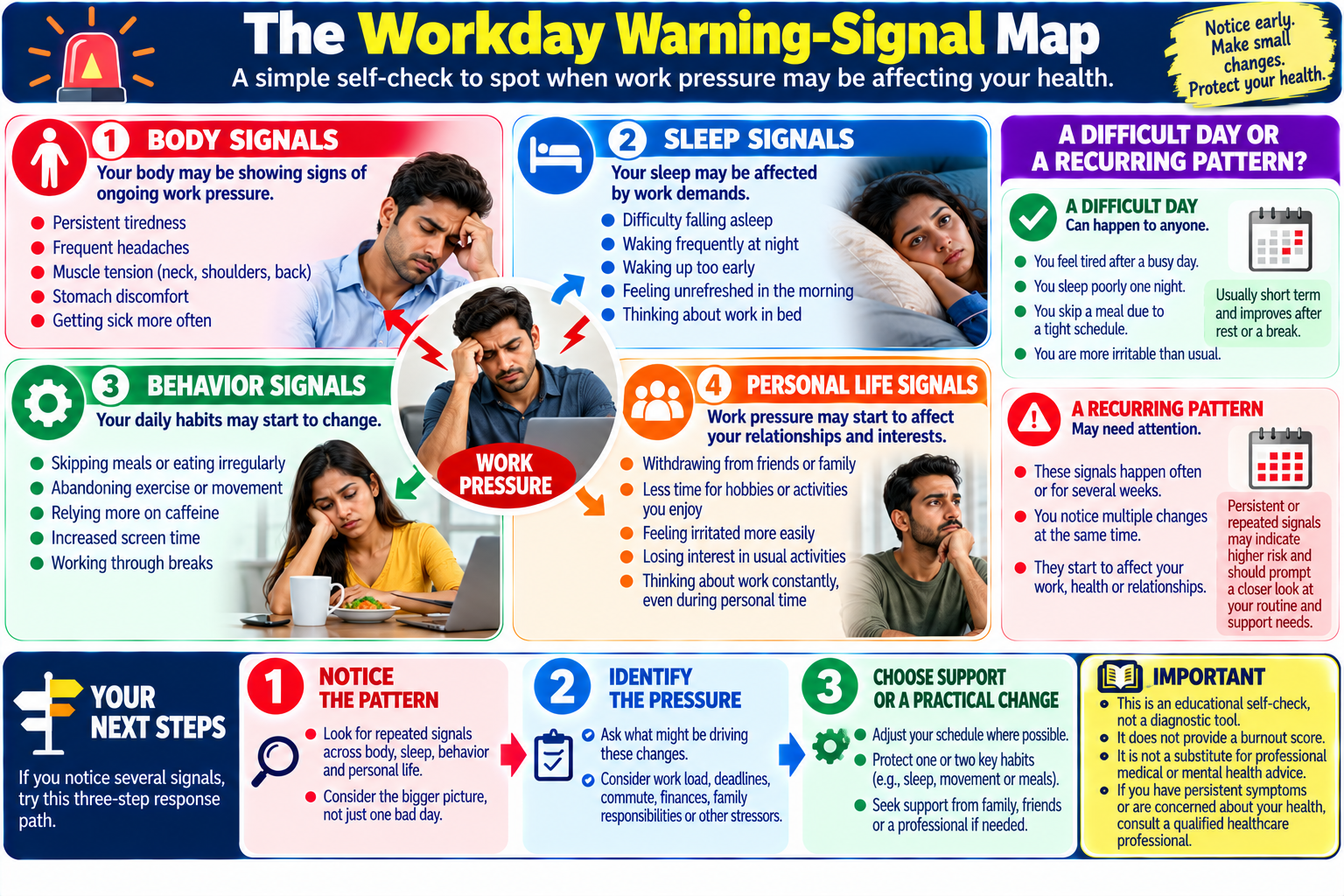
Work-life imbalance does not look exactly the same for everyone.
Your warning signs might include poor sleep, unusual irritability, persistent fatigue, loss of interest in normal activities, skipping meals, increasing caffeine use, stopping exercise, and avoiding friends or constantly thinking about work.
The CDC identifies symptoms such as fatigue, feeling overwhelmed or burned out, sleep problems, and difficulty concentrating among concerns that can occur with work-related stress. CDC: Supporting Worker Mental Health
Treat these changes as information rather than personal failure.
If your normal behavior begins changing for weeks rather than days, it may be time to look more closely at what is causing the strain.
12. Ask Whether the Problem Is Really Yours to Fix
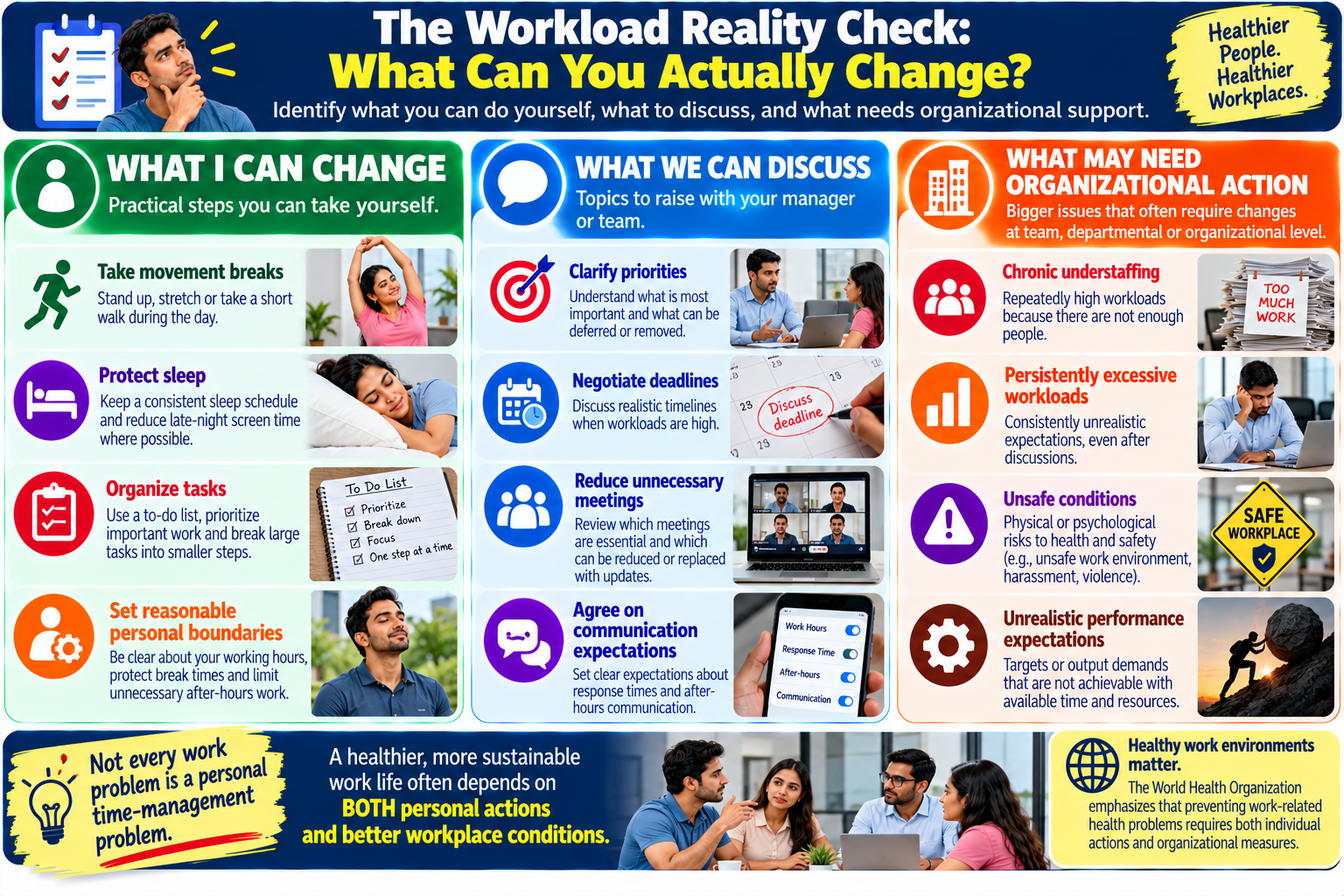
This may be the most important strategy in the article.
Sometimes people tell themselves:
“I need better time management.”
But the actual problem may be excessive workload, unrealistic deadlines, inadequate staffing, constant interruptions, poor management, limited schedule control, or excessive overtime.
Individual habits cannot completely solve an organizational problem.
WHO’s workplace recommendations therefore include organizational interventions, manager training, and changes to working conditions rather than relying exclusively on individual resilience. WHO: Guidelines on Mental Health at Work
A 2025 systematic review of workplace mental health programs also examined the value of approaches operating at multiple levels rather than relying solely on individual interventions. PubMed: Workplace Mental Health Programs and Burnout
If the source of the problem is structural, recognizing that fact is an important part of protecting your health.
A Better Work-Life Balance Strategy for Different Workers
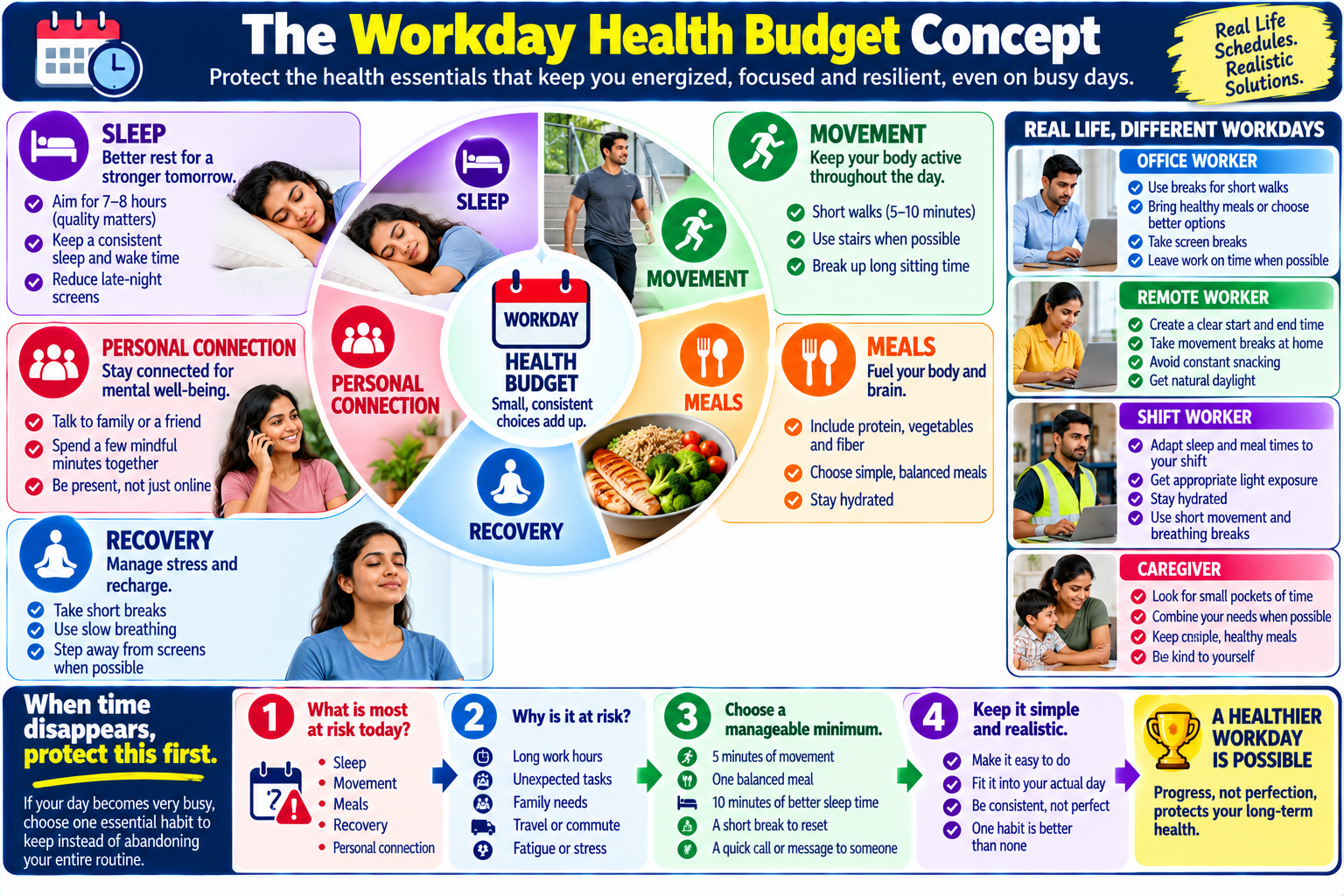
If You Work From Home
Your biggest challenge may be blurred boundaries.
A dedicated workspace, a fixed shutdown ritual, and a short walk before or after work can help separate professional and personal time. Avoiding work from the bed can also make the physical distinction clearer.
If You Work in an Office
Your biggest challenges may be prolonged sitting and constant interruptions.
Movement breaks, walking during suitable calls, taking lunch away from the desk and using stairs when practical can help make activity part of the workday.
If You Work Long Shifts
Your priority may need to be recovery rather than trying to fit an elaborate exercise routine into an already demanding schedule.
Protect sleep opportunities, plan practical meals, stay hydrated, and use manageable movement rather than forcing an exhausting workout when your body needs recovery.
If You Have Caregiving Responsibilities
A rigid routine may not survive an unpredictable day.
Instead, use minimum habits. A short walk, a simple nutritious meal, or ten minutes of quiet time can still count when a longer routine is impossible.
If You Are Self-Employed
Your biggest problem may be the absence of an external stopping point.
Create one yourself.
Set working hours, establish a shutdown ritual, and protect at least some part of your week from business activity.
A Simple Work-Life Health Scorecard
You do not need a specialized application to evaluate your routine.
Once a week, give yourself a simple score from 0 to 2 in seven areas:
| Area | 0 | 1 | 2 |
|---|---|---|---|
| Sleep | Poor | Mixed | Consistent |
| Movement | Very low | Some | Regular |
| Food | Mostly rushed | Mixed | Mostly balanced |
| Stress | Overwhelming | Moderate | Manageable |
| Boundaries | None | Some | Clear |
| Social connection | Very low | Occasional | Regular |
| Recovery | None | Some | Protected |
This is not a medical test and should not be interpreted as one.
Its purpose is to help identify patterns.
If one category repeatedly scores zero, that may be a better starting point than trying to improve everything simultaneously.
The 10-Minute Workday Health Reset
When your workday begins to feel overwhelming, try a short reset rather than waiting for a completely free afternoon.
Spend the first couple of minutes stepping away from your desk, then walk for several minutes and take a few slow breaths. Drink some water, identify the most important task remaining, and remove one task that genuinely does not need to be completed today.
Use the final minute to decide when you will stop working.
The goal is not to solve every source of stress in ten minutes.
It is to interrupt the automatic cycle of sitting, rushing, and reacting.
What the Latest Research Says About Work-Life Balance
Long working hours deserve attention.
The WHO and ILO analysis of global working hours found an association between working 55 or more hours per week and increased risks of stroke and ischemic heart disease compared with standard working hours. WHO/ILO: Long Working Hours
This is one reason long working hours should be viewed as an occupational-health issue rather than simply evidence of ambition or dedication.
Workplace interventions can reduce sedentary behavior.
Recent systematic reviews support the use of workplace strategies to reduce sitting time, including environmental changes and interventions that combine several approaches. PubMed: Workplace Sedentary Behavior
The benefit is not that every standing desk or walking break produces the same health outcome. Rather, changing the environment can make healthier behavior easier to perform consistently.
Burnout cannot always be solved individually.
Research into workplace burnout increasingly examines organizational as well as individual interventions.
A systematic review and meta-analysis found that organizational interventions may produce reductions in exhaustion, although the researchers also noted limitations and variation in the evidence. PubMed: Organizational Interventions and Occupational Burnout
More recent reviews continue to investigate workplace mental-health programs that combine individual and organizational strategies. PubMed: Workplace Mental Health Programs and Burnout
This supports an important people-first principle:
You should improve your personal habits where you can, but you should not automatically blame yourself for an unhealthy work environment.
Common Work-Life Balance Mistakes
Trying to Create a Perfect Schedule
A routine that works only on your best day is unlikely to survive a demanding week. Build flexibility into the plan from the beginning.
Treating Sleep as Optional
Sleep should not automatically be the first thing removed when work becomes busy.
Believing Exercise Requires a Gym
Walking, short strength sessions, and movement breaks can make physical activity more accessible without requiring a complicated setup.
Using Self-Care to Hide an Unhealthy Workload
A short breathing exercise may help you cope with a difficult moment, but it cannot permanently compensate for excessive workload or unsafe working conditions.
Saying Yes to Everything
Every unnecessary commitment takes time away from something else, including recovery.
Checking Work Messages Constantly
Continuous notifications can keep your attention connected to work long after the formal working day has ended.
Changing Everything at Once
Starting eight new habits on Monday may feel motivating, but it can quickly become overwhelming. One sustainable improvement is more valuable than a perfect routine that lasts four days.
Comparing Your Routine With Someone Else’s
A routine that works for a single professional may be completely unrealistic for a parent, caregiver, shift worker, or person with a different health situation.
The People-First Rule: Make Health Easier, Not More Complicated
Health advice often becomes another source of pressure.
Real people have difficult days. Some have young children, some work night shifts, and others have long commutes, caregiving responsibilities, or unpredictable schedules.
That is why the better question is not
“What is the perfect healthy routine?”
Ask instead:
“What is the smallest healthy action I can realistically repeat in my current life?”
For one person, it may be a ten-minute walk.
For another, it may be preparing tomorrow’s lunch.
For someone else, it may mean turning off unnecessary work notifications at the end of the day.
The best work-life balance strategy is the one that can survive real life.
A 7-Day Work-Life Balance Reset
Day 1: Observe
Before changing everything, notice where work is taking time away from sleep, movement, meals, relationships, or recovery.
Day 2: Protect Sleep
Choose a realistic time to stop routine work and protect the transition into bedtime.
Day 3: Add Movement
Introduce at least one short movement break into the workday.
Day 4: Improve One Meal
Make one meal more balanced and less rushed.
Day 5: Set One Boundary
Turn off unnecessary work notifications outside your chosen working period.
Day 6: Reconnect
Spend intentional time with someone important to you without allowing work to dominate the interaction.
Day 7: Review
Ask yourself:
What worked?
What felt unrealistic?
Which one change is worth continuing next week?
This is not a seven-day cure for work stress.
It is a practical experiment designed to help you discover which changes fit your life.
When Work Stress May Need Professional Support
Work stress is common, but persistent or severe symptoms should not simply be ignored.
Consider talking with a healthcare professional or mental-health professional if you experience persistent anxiety, depressed mood, severe sleep problems, loss of interest in normal activities, significant exhaustion, difficulty functioning, increasing substance use to cope with stress, or other symptoms that interfere with everyday life.
The CDC recommends seeking additional support when stress becomes difficult to cope with. CDC: Managing Stress and Mental Health
If you experience chest pain, unexplained shortness of breath, fainting, or other potentially serious physical symptoms, seek appropriate medical care rather than assuming they are simply caused by work stress.
If you are experiencing thoughts of self-harm or are in immediate danger, seek emergency assistance or an appropriate crisis service in your country.
Key Takeaways
- Work-life balance and health are connected, but balance does not require a perfectly divided schedule.
- Work can provide purpose, income, and social connection, while unhealthy working conditions can negatively affect well-being.
- Very long working hours are associated with increased cardiovascular risks in large WHO/ILO analyses. WHO/ILO evidence
- Sleep should be protected rather than treated as leftover time.
- Short movement breaks can help reduce prolonged workplace sitting.
- A “minimum healthy day” can make healthy habits more realistic when schedules become difficult.
- A work shutdown ritual can help create a psychological boundary between professional and personal time.
- Food preparation should make healthy choices easier rather than become another complicated project.
- Social connection is part of a healthy life and should not always be postponed until work becomes quiet.
- Burnout should not automatically be treated as an individual failure.
- Workload, schedule, management, and workplace culture can influence employee well-being.
- The most useful strategy is the one that fits your actual circumstances and remains sustainable.
Frequently Asked Questions
What is the best way to improve work-life balance?
Start with the area of your routine that is currently costing you the most health. For one person that may be sleep, while another may need more movement, better meals, or clearer communication boundaries. Improving one area consistently is often more realistic than rebuilding your entire life at once.
Can work-life balance improve physical health?
A healthier work routine can make it easier to protect sleep, physical activity, nutritious meals, recovery, and social connection. However, work-life balance is only one part of overall health and cannot replace appropriate medical care.
How many hours should I work to stay healthy?
There is no universal number that guarantees good health for every occupation or individual. However, WHO and ILO research found that working 55 or more hours per week was associated with higher risks of stroke and ischemic heart disease compared with working 35–40 hours. WHO/ILO
How can I balance work and exercise?
Do not wait for a large empty block of time. Short walks, movement breaks, and brief strength sessions can fit into many schedules. Over time, gradually work toward the physical-activity levels recommended for your age and health status.
Is working from home better for work-life balance?
Not automatically. Remote work can remove commuting time while also making it easier for work to spill into personal hours. A defined workspace, movement breaks and a clear shutdown ritual can help create healthier boundaries.
How can I reduce work stress naturally?
Begin with practical changes such as protecting sleep, moving regularly, maintaining social connection, taking genuine breaks, and establishing reasonable boundaries. If excessive workload or an unhealthy workplace is the main cause, individual lifestyle changes alone may not solve the problem.
Can taking breaks really help?
Breaks can provide opportunities to interrupt prolonged sitting and step away from continuous work demands. Workplace research has found that interventions can reduce sedentary time, although the size of the benefit and its broader health effects vary by intervention. PubMed: Workplace Sedentary Behavior
What is a minimum healthy day?
A minimum healthy day is the smallest version of your health routine that you can maintain when life becomes unusually busy. It could include a short walk, one nutritious meal, adequate fluids, a brief period away from screens, and a reasonable opportunity for sleep.
Author Note
Author: RVLNSV PRASAD
I believe health should fit into real life rather than require a perfect life.
My own experience taught me that repeatedly postponing sleep, movement, and personal time can gradually make a busy schedule feel even harder.
The solution was not to create a complicated routine. It was to protect a few important habits and make them easier to repeat.
That is the approach behind this article.
You do not need to change everything tomorrow. Choose one area that is currently costing you the most health and start there.
Medical Disclaimer
This article is intended for general educational purposes and does not replace individualized medical advice, diagnosis, or treatment.
Persistent stress, sleep problems, depression, anxiety, severe fatigue, chest pain, unexplained shortness of breath, or other concerning symptoms should be discussed with an appropriate healthcare professional.
If work-related stress is significantly affecting your ability to function or your mental health, consider seeking professional support.
Fitness Disclaimer
The movement suggestions in this article are general and intended for generally healthy adults.
If you have a medical condition, injury, significant pain, recent surgery, pregnancy-related exercise concerns, or other health considerations, obtain appropriate professional guidance before changing your exercise routine.
Start gradually and stop exercise if you experience concerning symptoms.
Sources
- World Health Organization — Guidelines on Mental Health at Work
https://www.who.int/publications-detail-redirect/9789240053052 - World Health Organization — Mental Health at Work
https://www.who.int/teams/mental-health-and-substance-use/promotion-prevention/mental-health-in-the-workplace/ - CDC — Supporting Worker Mental Health
https://www.cdc.gov/mental-health/caring/providing-support-for-workers-and-professionals.html - CDC — Managing Stress and Mental Health
https://www.cdc.gov/mental-health/living-with/index.html - WHO/ILO — Long Working Hours and Cardiovascular Disease
https://www.who.int/news/item/17-05-2021-long-working-hours-increasing-deaths-from-heart-disease-and-stroke-who-ilo - PubMed—Workplace Sedentary Behavior Interventions
https://pubmed.ncbi.nlm.nih.gov/38503064/ - PubMed—Workplace Physical Activity and Sedentary Behavior
https://pubmed.ncbi.nlm.nih.gov/40175011/ - PubMed — Workplace Interventions With Digital Elements
https://pubmed.ncbi.nlm.nih.gov/38641816/ - PubMed — Organizational Interventions and Occupational Burnout
https://pubmed.ncbi.nlm.nih.gov/37758838/ - PubMed — Workplace Mental Health Programs and Burnout
https://pubmed.ncbi.nlm.nih.gov/40861700/
Final Thoughts
A healthy work-life balance is not about escaping responsibility or pretending that work does not matter. Career goals, financial security, and meaningful work are all legitimate parts of a healthy life.
The problem begins when work consistently consumes the sleep, movement, relationships, and recovery that allow you to function well.
The strongest solution is therefore not a perfect daily schedule. It is a flexible system that protects the basics even when work becomes difficult.
Protect your sleep when possible, build movement into the workday, make nutritious food easier to choose, and create boundaries that are realistic for your circumstances. When the underlying problem is excessive workload or an unhealthy workplace, recognize that personal discipline alone may not be enough.
Work should be an important part of your life, but it should not require you to sacrifice the rest of your health.
Related Articles
- Healthy Habits Category
- Home
- The Future of Health: Shaping a Healthier America
- Balancing Health: The Key to Sustainable Energy and Health
- Breaking Bad Habits: How Americans Are Redefining Health and Wellness
- From Coast to Coast: Embracing a Best Healthy Lifestyle in the USA







[…] 12 Best Ways to Work Life Balancing Health : The American Health Challenge […]